How Much Does an Online Store Really Cost for a Caribbean SME?
Realistic budgeting, cloud infrastructure, ERP connectors, and break-even calculations for Caribbean businesses.
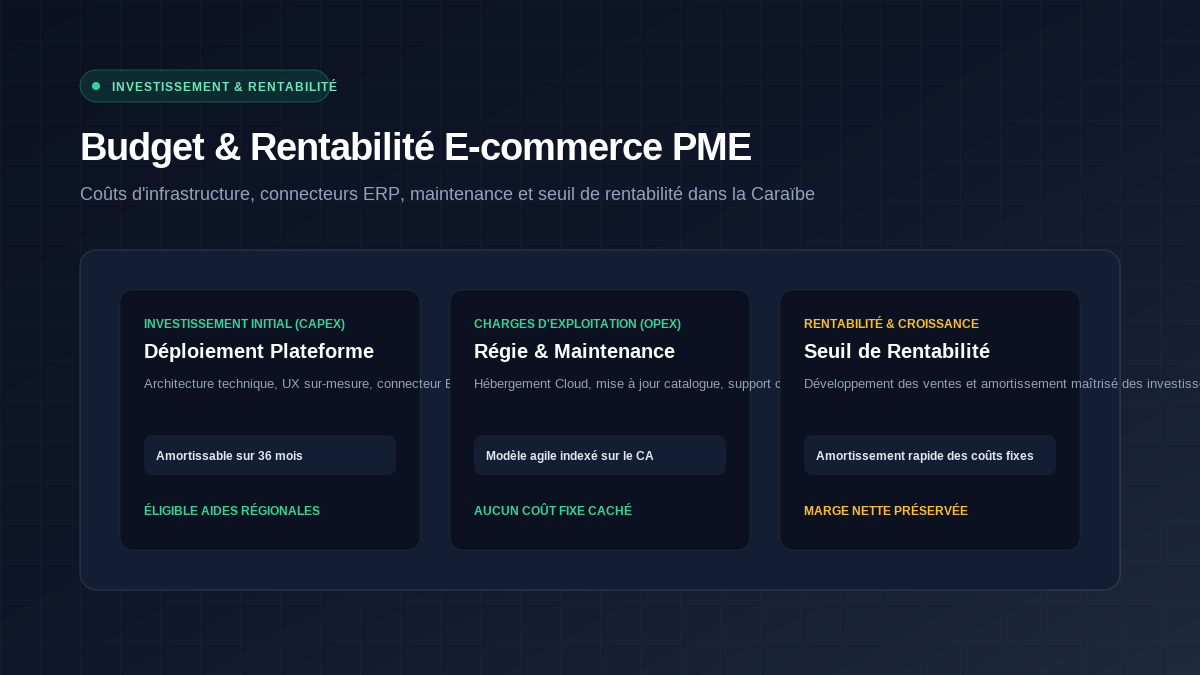
When a Caribbean SME, retail brand, or regional distributor decides to launch or modernize an e-commerce platform, the initial quoted price is often merely the tip of the iceberg.
Between insular freight integrations, central ERP synchronization (Sage, Cegid, Odoo), local customs compliance (dock dues / octroi de mer), and daily catalog merchandising, the true cost must be calculated across total cost of ownership (TCO) and expected return on investment (ROI).
1. Initial Investment: Foundations vs. Enterprise Architecture
A professional B2B or B2C e-commerce platform for an SME requires three foundational cost pillars:
- UX/UI Brand Experience & Conversion Engineering: Designing an interface adapted to local buyer behavior, mobile devices, and frictionless checkout funnels.
- Data Pipeline & ERP Connectors: Integrating inventory levels, customer master files, and wholesale price tiers directly with your company’s back-office software.
- Logistics & Customs Engine: Setting up shipping tables for inter-island routes, mainland export, and automated tax calculations.
| Scope | Standard SME Storefront | Omnichannel ERP-Connected Platform |
|---|---|---|
| Catalogue Volume | 100 to 500 SKUs | 1,000 to 10,000+ SKUs & Variants |
| ERP Integration | Batch CSV / Webhooks | Real-Time Bidirectional API |
| Customer Portals | B2C Checkout | B2C + Private Wholesale B2B Portal |
| Logistics Setup | Standard Parcel Carriers | Ocean Cargo LCL, Air Cargo & Couriers |
2. Operational Costs: The In-House vs. Delegated Model
Building the platform represents only the beginning of the commercial journey. A live store requires continuous operations:
- Technical Supervision & SLA: 24/7 server monitoring, security patching, and Core Web Vitals optimization.
- Catalogue Enrichment: Adding new collections, high-resolution imagery, and SEO-optimized specifications.
- Order Processing & Customer Care: Real-time customer chat, WhatsApp support, and tracking queries.
Attempting to staff these responsibilities internally with full-time hires incurs substantial fixed payroll overhead and turnover risk. Contracting an outsourced managed operations regie transforms these expenses into predictable, performance-aligned service fees.
3. Calculating the Break-Even Point
To validate your investment, determine the incremental gross margin needed to amortize your fixed digital setup:
$$\text{Break-Even Sales} = \frac{\text{Annual Fixed Operating Costs}}{\text{Average Gross Margin %}}$$
With a structured platform, Caribbean SMEs typically observe rapid operational efficiency:
- Elimination of stockout disputes via real-time ERP synchronization.
- Expansion into new regional Caribbean islands and mainland export channels.
- Higher average order value (AOV) on both wholesale B2B accounts and retail orders.
Conclusion: Engineering for Real Growth
Launching an e-commerce platform in the Caribbean is an infrastructure project that directly impacts your balance sheet. By aligning your technology stack with proven ERP connectors and operational delegation, your business turns digital commerce into a durable, profitable growth driver.